Markey family home
All the Bright PlacesThe Markey family home is a threshold between privacy and family life in Violet Markey’s story: a place where she can shut herself away, where Theodore Finch can arrive unexpectedly at her window, and where her parents’ care becomes a source of both comfort and conflict. Its most significant spaces are not described through architectural detail but through what happens in them—Violet’s bedroom, the dinner table, and Eleanor Markey’s preserved room. Together they register Violet’s changing relationship to grief, independence, and the family that remains.
Rooms and Private Boundaries
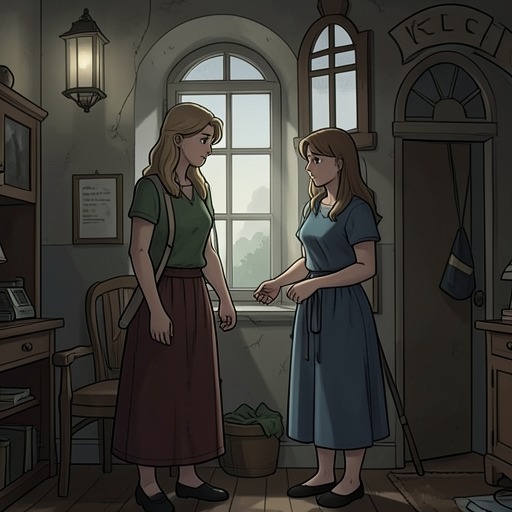
At two on a Wednesday morning, Violet wakes to rocks striking her bedroom window. Looking through the blinds, she sees Theodore Finch in the front yard, wearing pajama bottoms and a dark hoodie. The ordinary boundary between the house and the outside world has become an invitation he has crossed without warning: Violet opens the window, but tells him to go away. Her response is not simple rejection. She is angry with Finch for getting her detention, with Ryan Cross for assuming they are together again, and with herself for the kisses that have encouraged that assumption. The bedroom gives her a place from which to express the frustration she has not resolved elsewhere, while the window makes that private space abruptly answerable to another person.
The home also contains a private ritual tied to Violet’s imagined future. In her bedroom, she keeps a calendar marked with the days remaining until graduation and freedom, and a black marker within reach for crossing off each day. One night she realizes she has forgotten to mark the date. Rather than resume the routine, she freezes while looking at the remaining days and feels apprehension about what will follow graduation. She tears down the calendar, folds it away in the back of her closet, and puts the marker with it. This small action changes how the room holds time: a countdown that once made the future legible is no longer something she can keep facing day after day.
Family Concern and Friction
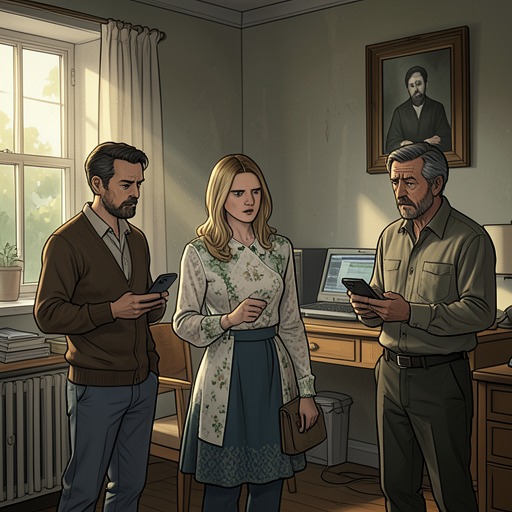
The family home is also where Violet encounters her parents’ disappointment directly. After they learn that she has skipped school, Sheryl tells her they are very disappointed. Violet experiences the words as painful partly because her parents do not respond by grounding her or confiscating her phone or computer. Their usual method is to talk to her, making their disappointment feel personal rather than like a punishment imposed from outside. Sheryl says that the behavior is unlike Violet, and James begins to remind her that she is good at many things. Violet leaves for her room before that conversation can settle the conflict.
Afterward, the family eats dinner almost in silence. Sheryl goes upstairs and studies the bulletin board above Violet’s desk. Seeing that EleanorandViolet.com has been abandoned, she asks about it; Violet says there is no point in keeping it. Sheryl’s eyes are red, and her quiet response makes clear that the website’s disappearance touches a loss the two of them share. But she does not leave the conversation there: she taps the paper announcing a new, nameless web magazine and asks Violet to tell her about it. In the same bedroom, mourning and the possibility of a new project sit side by side. The exchange gives Violet’s emerging work a place in family life without pretending that it replaces what has been lost.
Eleanor’s Room and Shared Grief
Violet’s visit to Eleanor’s closed bedroom is another distinct movement through the house. She pushes the door open and sees yellow walls covered with photographs of Eleanor and friends from both Indiana and California. A California state flag hangs above the bed; art supplies remain piled in a corner. Sheryl and James have been slowly organizing Eleanor’s belongings. The room thus holds several parts of Eleanor’s life in one place, while the gradual work of sorting her things shows that the family’s response to her death is still in progress.
Violet enters after putting away her graduation calendar, moving from an object that had made her uncertain about her own future to a room filled with her sister’s past. The contrast is grounded in the house’s actual objects: the calendar and marker hidden in Violet’s closet, and the photographs, flag, and art materials in Eleanor’s room. The narrative does not present the latter as a completed memorial or a resolved grief. Her parents are still working through the belongings, and Violet goes into the room after a night of fear about what comes next.
A Home Under Strain
The house becomes a site of acute parental alarm after Violet has been away late and does not answer her phone. When she returns with Finch, Sheryl is crying; James asks whether Violet is safe. Their response follows a chain of worry: they called Amanda Monk to find out whether she had seen Violet, and Amanda said Violet was probably with Finch, the boy whose life Violet had saved. Sheryl tells her daughter that they are trying to do what is best. Violet’s answer is that they do not trust her. The exchange makes the home’s protective function inseparable from a struggle over Violet’s freedom: her parents’ fear is real, but from her perspective their concern has become a limit on her ability to choose.
Across these episodes, the Markey family home changes meaning with the people who enter its rooms and the conversations they can bear to have there. It shelters Violet’s private anger and her attempt to imagine a future; it also exposes the costs of secrecy, the persistence of family grief, and the difficulty of protecting someone without controlling her. Its significance lies less in a detailed physical portrait than in this recurring tension: the house is both a place Violet withdraws into and a place where her choices become visible to the people who love her.